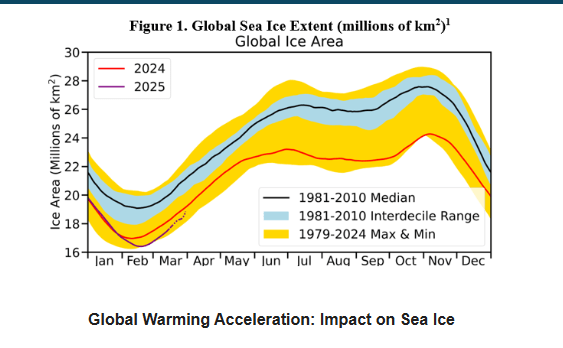
Source: https://mailchi.mp/caa/global-warming-acceleration-impact-on-sea-ice?e=737fb9744c
Simplified Summary:
The Earth is heating up faster than before. This extra heat is not just melting floating sea ice, but also massive land-based ice sheets, glaciers, and ice caps. These meltwater sources—especially from ice sheets and icebergs—release cold freshwater into the oceans, which can temporarily lead to more sea ice in some areas. But overall, the warming ocean is melting more sea ice than is being created, and today, sea ice around the world is near its lowest level in recorded history.
In the Arctic, sea ice has been moderately stable over the last 10 to 20 years. However, warm ocean water from both the Atlantic and Pacific is pushing farther into the Arctic Ocean, and that may soon accelerate ice loss. Historical climate data suggests that this kind of hidden warming from below can trigger sudden and dramatic sea ice loss, especially near Greenland—affecting the larger Greenland ice sheet.
In Antarctica, the warming ocean is also melting floating ice shelves more quickly. This can lead to more freshwater entering the sea, which might briefly cause more sea ice to form. But this effect is only temporary and doesn’t reverse the long-term trend of ice loss.
Importantly, many of the computer models used by the UN’s climate science body (the IPCC) don’t fully capture how this freshwater influences sea ice. For that reason, these models may be underestimating how sensitive the climate really is to greenhouse gas emissions.
In short, the recent acceleration in global warming raises serious concerns. It increases the risk of ice sheet collapse, disrupts ocean currents that regulate the climate, and raises sea levels—outcomes we could see playing out over the coming decades.
 My blog