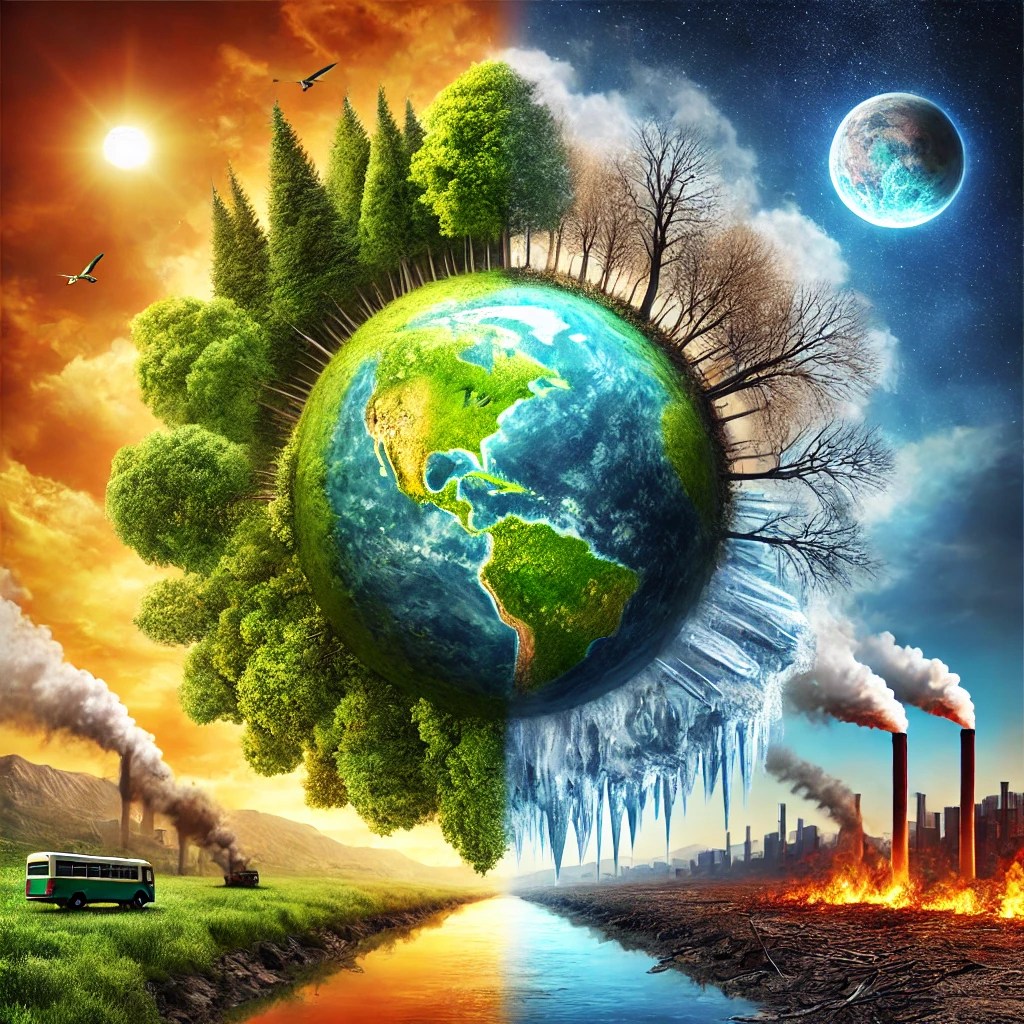
Comments on the report: The 2024 state of the climate report: Perilous times
on planet Earth, created by renowned climate scientists like Johan Rockström and Stefan Rahmstorf from Potsdam Climate institute and many more scientists from around the globe. You find the report here:
https://academic.oup.com/bioscience/advance-article/doi/10.1093/biosci/biae087/7808595?login=false
2024 Climate Report: Business as Usual in a Time of Crisis
As we stand in 2024, the latest climate report offers little optimism. Despite decades of scientific warnings, international agreements, and increasing awareness, we are still moving toward a climate catastrophe with no significant course correction. The numbers tell a clear and sobering story: humanity is continuing on the same path as if nothing serious is happening. Here’s a closer look at what the 2024 State of the Climate Report reveals.
Record Temperatures—A New Normal?
One of the most glaring indicators that we’re not on the right track is the temperature data. In 2023 and 2024, both global and North Atlantic sea surface temperatures shattered records. Not by small margins, but by huge leaps that signal how deeply entrenched global warming has become. Scientists warn that these are not just one-off events but a reflection of a new normal where extreme heat becomes more frequent and severe.
Global mean temperatures have also risen to record levels, with 2024 expected to be one of the hottest years on record. It’s worth noting that this heat isn’t evenly distributed. While some areas face intense heat waves and droughts, others see unusual storms and flooding. Regardless, these are all symptoms of the same underlying problem—unchecked global warming.
Fossil Fuels: Still the Elephant in the Room
Despite the overwhelming evidence that fossil fuels are driving climate change, our global addiction to coal, oil, and gas remains as strong as ever. The report makes it painfully clear: fossil fuel consumption increased by 1.5% in 2023, continuing a trend that has been in place for years. Even as renewable energy sources like wind and solar are growing, they still only cover a fraction of our total energy needs. In fact, fossil fuel consumption is still 14 times greater than solar and wind energy combined.
This mismatch between rising renewable energy use and the ever-growing consumption of fossil fuels shows that we are not doing enough to phase out the sources of emissions. Instead, we are essentially maintaining the status quo, while giving the impression that the energy transition is moving in the right direction. But the numbers do not lie—renewables are far from catching up to the scale needed to make a meaningful impact.
Greenhouse Gases: Still on the Rise
As if the rising temperatures weren’t enough, the concentrations of greenhouse gases in the atmosphere are also at record highs. Carbon dioxide (CO2), the primary driver of climate change, has surged past previous records. Even more concerning is the accelerated growth of methane emissions—a greenhouse gas far more potent than CO2 in the short term.
This increase is especially alarming because methane has a relatively short atmospheric lifetime. Reducing methane emissions could be one of the quickest ways to slow down global warming. However, instead of seeing progress, we’re witnessing the opposite—methane levels are climbing, pushing us even closer to tipping points that could have devastating effects.
Deforestation and Ecosystem Collapse
Our ecosystems are also bearing the brunt of climate change, with forests playing a particularly tragic role. Global tree cover loss hit 28.3 megahectares in 2023, driven in large part by massive wildfires that have become more frequent and severe due to rising temperatures. These losses aren’t just about the destruction of nature—they directly impact our ability to capture and store carbon.
While the Amazon rainforest, often called the “lungs of the Earth,” has seen a slight reduction in deforestation rates, it is still far from safe. The Amazon is nearing a critical tipping point, where deforestation and climate change could cause large parts of it to shift from being a carbon sink to a carbon source, accelerating global warming even further.
Extreme Weather: The New Reality
The year 2023 and early 2024 have been marked by unprecedented climate-related disasters. From devastating wildfires in Chile to deadly heatwaves in Asia and the Mediterranean, extreme weather events have become more frequent and severe. The report notes that human-caused climate change has made such events more likely and more intense, with storm surges, floods, and heatwaves killing thousands and displacing millions.
The impacts are particularly harsh for the most vulnerable populations, especially in the Global South, where many lack the resources to adapt to such rapidly changing conditions. This raises critical questions about climate justice and the unequal distribution of climate impacts.
Where Are We Headed?
Perhaps the most unsettling takeaway from the report is the projection for the future. Under current policies, we are on track to reach around 2.7°C of warming by the end of this century—far beyond the 1.5°C limit set by the Paris Agreement. Scientists agree that every fraction of a degree of warming brings with it more severe consequences: more extreme weather, higher sea levels, and greater threats to food and water security.
What’s particularly troubling is the presence of so-called “feedback loops.” These are processes, like the melting of permafrost, that once triggered, can amplify warming and push us toward tipping points from which there may be no return. If we pass these thresholds, large-scale changes could be locked in, making it impossible to reverse course even if we drastically cut emissions in the future.
Business as Usual?
In conclusion, the 2024 State of the Climate Report paints a grim picture. Despite knowing the risks, we continue to act as if we have all the time in the world. The reality is, we don’t. The KPIs presented in this report—record temperatures, rising emissions, increasing deforestation, and worsening extreme weather—all point to a world where business as usual is pushing us toward disaster.
This isn’t just a failure of policy or technology; it’s a failure of imagination and political will. We need bold, transformative action—now. From rapidly phasing out fossil fuels to addressing the inequities of climate impacts, there is no shortage of solutions on the table. What’s missing is the global commitment to put these solutions into practice. Without it, the future will be much hotter, much more dangerous, and far less predictable than we can afford.
It’s time to stop pretending that incremental changes will be enough. The window for meaningful action is closing fast, and what we do in the next few years will determine the future of our planet for generations to come.
As an electrical and software engineer, I struggle with the insight that we engineers and scientists actually made this all possible. We unlocked the potential of machines getting much stronger forces than any a live being ever could have, up to the point that they outnumber us in intelligence.
A very effective engineering approach in getting there was the “facade pattern“. In my childhood, this principle culminated into the remote control of TV sets. No user of such equipment had to know anything about frequency modulation, intermediate frequency or in digital time the Shannon theorem. You simply press a button which stands for a particular single action, not conflicting with actions related to other buttons. System designers call that orthogonality of the system parameters, enabling the hiding of complexity behind a system. This point of orthogonality is significant to achieve because no one understands if you press e.g. the button to make the screen brighter and, in addition, you make the sound louder. But in fact, many parameters of a system are heavily interconnected with each other. To decouple or at least only loosely couple them is the actual engineering task. If you achieve this goal, you will have a powerful and widely accepted tool to regulate your system. Ships, planes and cars were the first machines where this facade pattern was pushed to the limit, and self-driving cars are not only fiction but reality. But the computer itself, the internet and artificial intelligence are the cornerstone of the facade pattern.
Unfortunately, we decoupled more than the systems parameters complexity, we decoupled the whole humanity from mother nature else I cannot understand humans behavior. This decoupling prevents people’s understanding of our position in this vast cosmos:
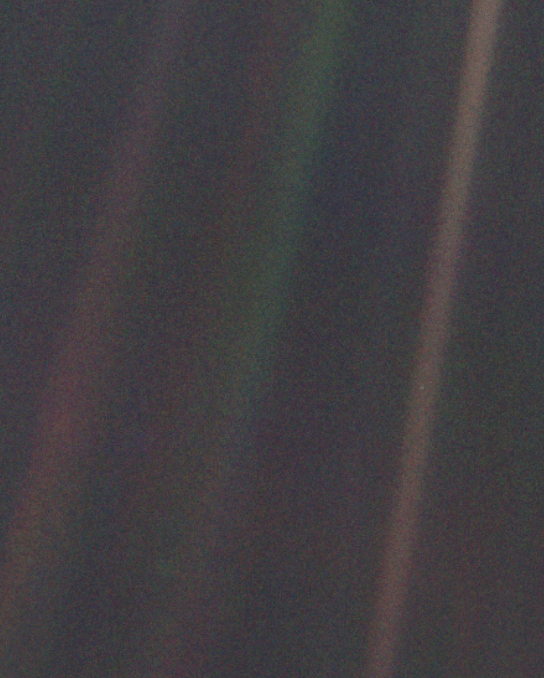
This photo from Voyager I should remind us that our existence is very much dependent on the habitability of the planet. Everything outside the Earth, what is in any realistic reach of our technology in the next, let’s say 20–30 years, is tremendous hostile and actually not survivable. So it’s not very clever to ruin the habitability of our planet, unless we at least have a reliable alternative.
Let’s focus on two aspects of the report:
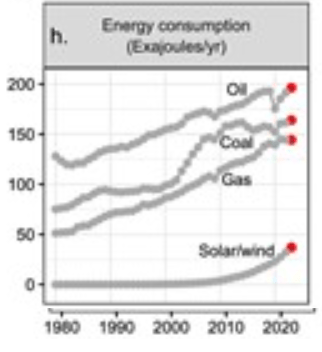
The diagram is rather small in the report, but you get the gist quickly. Renewable Energy is growing exponentially, but the fossil fuels stagnate or grow slightly at a much higher level than renewables currently are. You get the impression that many countries welcome renewables but rather as a supplement than a replacement. The organization https://www.switchcoal.org/ has found out that coal regions are excellent places to install solar panels and wind turbines for creating renewable energy. I can only confirm that the technology including energy storage and smart grids can enable us for many happy years to come, but without the will to migrate quickly to renewables replacing fossil fuels, it will be the opposite.
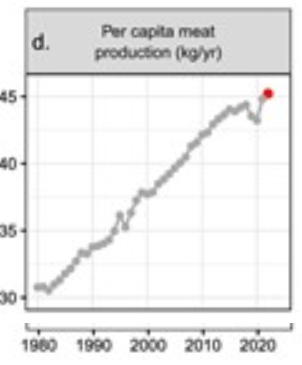
Also, the above diagram is heading unfortunately into the wrong direction. There was a short period when a reduction in meat production occurred, but this reverted dramatically again. By becoming vegetarians or vegans, we could create a big space of recreation for our planet because massive areas for growing ped food could be released to mother nature. This adaption from economical to psychological aspects, from meat eater to vegetarian/vegan eater is actually quite affordable, but for most people it seems impossible.
A species that interprets “survival of the fittest” as a thing of how to manipulate nature to its needs can be regarded as a brave species, but not necessarily a clever one.
But the facade pattern could see another survival track with imaginable extended effort in technology. Life on Earth will definitely get harder to survive, you need to adapt, but since we are not willing to make the necessary changes, we will adapt our virtual space simulating that the world is as we know it from our ancestors.
The movie Matrix stunningly pointed into this direction of evolution. Today, image recognition and classification AI software can already decode (still on a limited level) a human’s view by decoding MRI signals:
https://www.scientificamerican.com/article/ai-can-re-create-what-you-see-from-a-brain-scan/
I don’t think it’s too unrealistic that AI systems can manipulate our brain in a way that we perceive the world in a much different way as it actually will be within the next 20-30 years.
According to my personal observation already today, still most of the people see a much better world ahead as I see and those scientists of the report: The 2024 state of the climate report: Perilous times on planet Earth.
Advancement in AI technologies could work out the pattern to its core meaning: Facade
 My blog