This blog was created by using AI System ChatGPT 4.0.
The Reason for this blog post is the latest findings of the climate researchers: James Hansen, Makiko Sato, Pushker Kharecha.
James E. Hansen is renowned in climate research for his early warnings about global warming, notably his 1988 testimony before the U.S. Congress, which brought the issue of climate change to widespread public attention. As a former director of the NASA Goddard Institute for Space Studies, his pioneering work in developing and using climate models to predict climate change impacts has made him a central figure in environmental science and advocacy.
https://en.wikipedia.org/wiki/James_Hansen
In the quest to understand and combat climate change, voices like that of James E. Hansen, a leading climate researcher, are invaluable. Hansen’s recent comments shine a light on the complexities of global warming and challenge us to rethink our strategies for the future.
The researches see in their analyzed global temperature data an acceleration of the temperature growth on decades level:
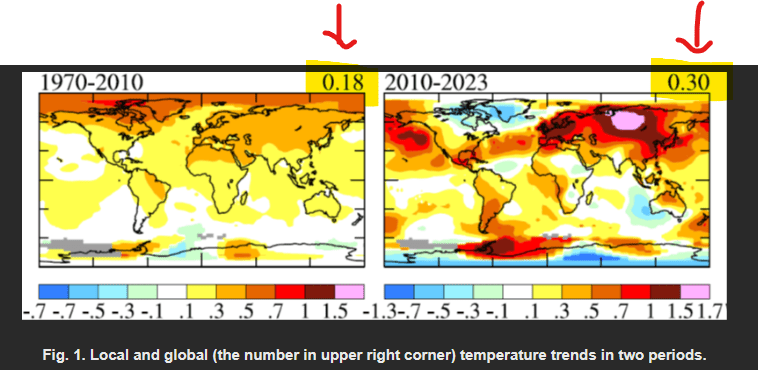

As you can see from the upper chart (base temperature data comes from NASA https://climate.nasa.gov/vital-signs/global-temperature/?intent=121) the slopes of the linear fits for the given time periods are clearly increasing.
Here’s what you need to know, broken down into more digestible pieces, why we see this development according to James E. Hanson and others.
The Current Climate Dilemma
Imagine our planet like a patient in a delicate state of health, with human activities tipping the scales towards fever. Hansen points out that we’ve been underestimating two critical factors in this equation: how sensitive our planet is to increases in greenhouse gases, and how much cooling aerosols (tiny particles in the air) have been helping us by offsetting some of the warming. It’s akin to realizing a fever is higher than the thermometer initially indicated.
Clean air is essential for our health, but paradoxically, reducing air pollution can temporarily accelerate global warming by removing aerosols that help cool the Earth. However, intentionally polluting to cool the planet is not a solution; we must focus on sustainable ways to reduce greenhouse gases without compromising air quality.
The Issue with Current Climate Models
Our global efforts to predict and mitigate climate change have leaned heavily on complex simulations known as Global Climate Models (GCMs). While incredibly sophisticated, Hansen argues these models miss the mark by not accurately accounting for the full effects of aerosols and the Earth’s sensitivity to greenhouse gases. It’s like using an outdated map to navigate a rapidly changing landscape.
What’s at Stake?
The ramifications of underestimating these factors are profound. Preserving the world as we know it, including our coastlines, ecosystems, and the global climate itself, may require us to do more than just halt global warming—we might need to reverse it. Yet, the path forward is unclear, muddied by optimistic policies that overlook the pressing energy needs and goals of burgeoning economies around the world.
A Call for Action
Hansen’s critique is a clarion call for a new direction. He urges us to move beyond wishful thinking and to adopt a more realistic approach to climate science—one that accurately reflects the nuances of our planet’s climate system and informs more effective strategies for mitigating climate change.
So, what can we do? Here are a few takeaways:
- Enhance Climate Models: We need better data incorporation and understanding of climate sensitivity and aerosol impacts.
- Cut Down on Emissions: It’s imperative to drastically reduce greenhouse gas emissions through renewable energy, energy efficiency, and moving away from fossil fuels.
- Innovate and Adapt: Investing in carbon capture technologies, sustainable infrastructure, and global policies that genuinely address the scale of the problem.
- Educate and Mobilize: Raising awareness and fostering a society that understands the stakes and is committed to sustainable living and policymaking.
The Path Forward
James E. Hansen reminds us that the journey toward a sustainable future is fraught with challenges and complexities. Yet, he also reiterates the possibility of a brighter future for the next generations. The solutions require not only scientific innovation and political will, but also a global acknowledgment of the shared responsibility we hold.
 My blog